Showing posts with label tourism. Show all posts

Thursday, 14 July 2016

Castilla y León

Elise and I have not long returned from a trip to a part of the north of Spain with which we were not previously familiar, Castilla y León.

The initial idea was to go to León and from there to drive further to Bilbao. That's not the way it worked out, however, and instead we visited a number of other places in the same autonomous community as León itself.

The main purpose of the trip was to see the Pantheon of San Isidoro in León, and to visit some Romanesque churches. A strange goal for a couple of atheists, you might think, but we look upon these treasures perhaps in a different way to that in which Christians (and so-called Christians) do.

The trip was a great success: León is an excellent mixture of old and new and harbours plenty of interesting things to see.  From León, we travelled to Astorga, and from there to Zamora; we then drove via Toro to Segovia, which we had altready visited a few years ago, but this time went with the purpose of seeing the gardens of La Granja.

Sadly, photography is very restricted in most of the ancient attractions, so here are some links to sites where others present a visual appreciation:

Royal Pantheon of San Isidoro, León

Virtual reality visit to Zamora, including three excellent views of the Flemish tapestries

Flemish tapestries of Zamora (information in Spanish)

Romanesque churches of Zamora

Portal of the collegiate church of Santa María, Toro

I have placed some photos that Elise and I took during the trip on Flickr:

León (incl. Parador, cathedral, Gaudí building…)

Astorga (with one of only two Gaudí buildings outside Catalunya)

Zamora and Toro

La Granja (gardens and fountains)

Thursday, 27 March 2014

In Belgium


So here we are in Belgium.

We left Guardamar last Thursday morning and drove to Jaca, in the Pyrenees, where we spent the night in the very pleasant Eurostars Reina Felicia hotel. It would have been even more pleasant if a couple of brats had not been allowed to use one of the corridors as a practise area for the 100 metre sprint and their parents had not then punished one of them by locking him out of their room, prompting him to scream his head off for a good ten minutes.

Still, the room was excellent, very clean, very well equipped, and the hotel was in a quiet location, just outside the town of Jaca. Of course, it would have been much quieter without the aforementioned couple of brats, who also made their presence known in the breakfast-room. A very good breakfast buffet, incidentally.

After Jaca we drove through the Somport tunnel into France. An impressive tunnel of some nine kilometres in length. Then onto Pau, the worst part of the journey, not because of the scenery, which is often spectacular, but because of the drive around the intervening town of Oloron-Sainte-Marie, which is very slow. By the evening of the second day we had arrived in Tours. Nothing at all special about the relatively cheap French hotel there, except that it was more expensive than the hotel in Jaca and offered considerably less quality and comfort.


We had intended to visit Brittany on our journey from Spain to Belgium, but the French weather reports were so bad for that part of the country that we simply drove straight through to Belgium. Well, that's not entirely true, as we did make a slight detour in order to visit the village of Bergues in French Flanders. Bergues was the main location for the hilarious French film, Bienvenue Cez Les Ch'tis, an we wanted to see the real thing. We thought it would be a good idea to get a packet of chips and a frikadel from the baraque à frites on the Grote Markt, but sadly we learned that the mobile chip-shop was put there only for the film. Still, we had a cup of coffee in the café that was the scene of the bicycle crash (Café de la Porte in the film, but Café de la Poste in reality) and also visited the belfry, which played such an important part in the film, so all was not lost!

The Grote Markt (Grand Place) without the baraque à frites, but with the impressive belfry.

In the tourist information office (in the belfry) one of the post-bikes from the film.

The location of the bicycle crash, the Café de la Porte/Poste


From Bergues it was just a relatively short drive to Heusden, near. Gent, where we arrived at about seven-thirty on Saturday evening.

- Posted using BlogPress from my iPad

Friday, 8 November 2013

39 again

A couple of days ago I had a birthday.

I have one each year.

This was the 27th occasion of my 39th birthday and as this seemed to be the cause of extra celebration, SWMBO decide that we should go to a restaurant to have a celebratory meal. She even decided on the restaurant at which we should dine, her current favourite, the Restaurante El Rebate, near Pilar de la Horadada, some thirty kilometres from where we live.

El Rebate was the name of a small abandoned village that the Van Iseghem family completely restored, eventually creating the restaurant itself, as well as a wedding chapel and a shop selling a wide variety of wines, other groceries, handicrafts and all sorts of other things, whilst avoiding the more tacky tourist fare.

The restaurant occupies a large building that was once several small houses. In addition to the large dining room it has a huge terrace.

As usual, we enjoyed our meal at El Rebate and will no doubt be returning soon.

El Rebate seen from the parking area
Steps up to El Rebate from the parking area
Restaurant area of El Rebate


Main restaurant building
Terrace, which would soon be full
SWMBO contemplates the cold tapas
SWMBO admiring the desserts


A Belgian biscuit, a Spanish restaurant, a Welsh man

Friday, 25 October 2013

A Load of Bull(s)

There seems to be a very strange ambiguous attitude towards bulls here in Spain. People purport to have great respect for the animals and then promptly turn round to organise nonsensically cruel "traditions" such as bullfighting, or chasing the bulls through narrow streets, or making them jump off harbour walls, or running after them with spears on horseback, or tying flaming torches to their horns, or…

Well, you get the picture. For a supposedly civilised country still to allow such cruelty is just crazy. And the excuse that it is all done in the name of tradition is too pathetic to be taken seriously.

Anyway, there are bulls in Spain other than those poor creatures who have to undergo such senseless treatment. Sadly, few people, either in or out of Spain, seem to know about them, so here's a piece to whet your appetite.

We recently travelled to Belgium by car. SWMBO had decided that it would be a good idea to visit Toledo on the way, so we decided to make a trip of it and to also visit Avila and Segovia. Well, on the road between Toledo and Avila I noticed a small sign pointing to the Toros de Guisando. That rang a bell; somehow I knew something about these bulls, but I had no idea from where. Anyway, it was a quick left hand down a bit in order to turn onto the direction indicated. Within a couple of kilometres we arrived at the location of the bulls. In fact, we almost drove past the place, as it is so poorly indicated.

There is just a small parking area at the side of the road with a couple of very small signs, hidden by the branches of some large trees, to point out to the weary traveller that this is the place.

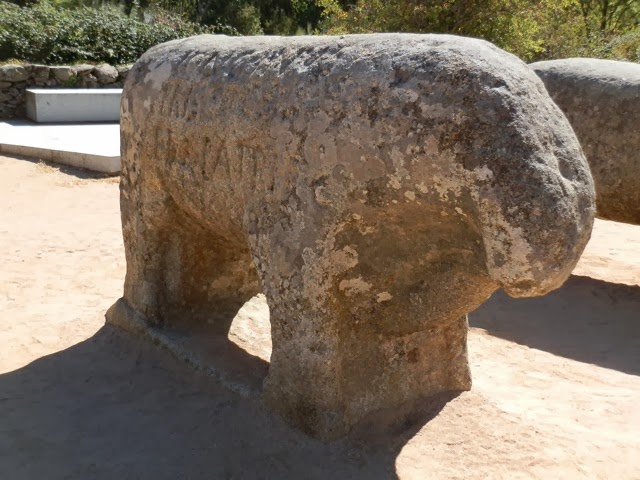
Behind a fairly substantial wall, hidden from view of passing traffic and with just a single small entrance gate, is an open area of ground in which stand four magnificent stone bulls.

The bulls are over two thousand years old and were once spread over the surrounding fields. Nobody knows their purpose: magical, religious, fertility symbols…? Perhaps there were more such bulls in the area, certainly the types of rocks that lie in the fields offer plenty of suitable raw material. In any case, these four were brought to their current location probably in Roman times, in about the third century.

Each sculpture is about two metres long and perhaps one metre-thirty high. The carving is naive, but very beautiful and the bulls present a very strong impression. They each seem to have its own character. They are, of course, well weathered, but remains of exceptional detail can still be seen, most notably in the skin folds on the neck of one of them.

Carving details still visible

Another bull carries a Latin inscription that dates from the time that the Romans moved them.

Latin inscription on side of bull

Although the site of the bulls seems to be little known nowadays, it must have been held in some esteem in times gone by, for it was here that Enrique IV proclaimed his sister, Isabella the Catholic, as his rightful heir to the Kingdom of Castilla in 1468.

A small information panel provides some history


Friday, 11 November 2011

Museo de Belenes, Alicante

If you have an hour or so to spare in Alicante, a very pleasant way of passing the time is to visit the Museo de Belenes. Belenes is the plural form of Belén, or Bethlehem. In fact, the word is used here to indicate a nativity scene.

You don't have to be Christian to enjoy the displays of modelling that are exhibited in this small, but well looked after museum. I'm an atheist, but have been fascinated by the Spanish tradition of Belenes since I first discovered it some ten years ago and can only admire the work and dedication that goes into setting up these delightful models.

You can find Belenes all over Spain during the weeks leading up to the celebrations of the winter solstice (used by Christians to celebrate the birth of Jesus Christ) and on to Epiphany. They range in size from small scenes that people set up in their homes to very large scenes, sometimes displayed by a village or town, either outside, or, as in Guardamar, in a special room. Sometimes the scenes are extremely large, covering many square metres, often set up by local enthusiasts. San Javier, where the Murcia airport is located, claims to have the largest open-air Belen of Spain, covering 520 square metres and incorporating more than 1200 model figures with many moving elements. Another large one not too far from Guardamar is to be found in Casillas, a suburb of Murcia. This Belén is under cover and is particularly well known for its many moving parts.

Almost all Belenes have a secret: somewhere, hidden in the scene or scenes depicted, is a man crouching down, with his trousers around his ankles, doing his business. He is known as El Caganer (the crapper) and is said to be fertilizing the soil of the Belén, so that it will flourish again the following year. Probably originating in Catalonia, the caganer has become a popular element in Belenes and a small industry has grown around this single figure, selling not only the traditional form, but others, too, often depicting well-known personalities, including royalty and politicians, such as Barak Obama and Angela Merkel, to name but two.

I have to admit that I did not notice a Caganer in the museum, which was something of a disappointment, but otherwise the museum is a jewel, with many typically Spanish displays, as well as numerous nativity scenes from other parts of the world. The models are made of all sorts of material, ranging from clay, to wood, to ceramics, as well as less likely materials.

Entry to the museum is free. It is open from Tuesday to Friday, from 10:00 until 14:00 and from 17:00 until 20:00. You can find more information and a map of the location of the museum here.

I have made a small Picasa album, showing the inside of the museum.

Wednesday, 7 September 2011

Paella fiesta

Sunday saw the annual Paella-making competition in El Campo de Guardamar, part of the San Isidro fiestas of that hamlet of Guardamar del Segura. Anyone can take part in the competition, but you have to be able to make a paella in the open-air, using a simple wood fire, with the paella dish supported on a tripod-like affair over the fire.

Many of the paellas thus prepared are very large, sufficient for twenty people or more, and are prepared by teams; others are much smaller efforts, some even prepared by just a single person. The size is irrelevant; the finished paella is judged purely on taste.

This year some twenty paellas were made. These are prepared in the street, the fires being built on a thick layer of sand, which protects the underlying tarmac. (When I was in the UK recently, I was explaining the procedure and a British person took umbrage at this, loudly proclaiming that the EU wouldn't allow such a thing in the UK, but that anything goes in the rest of Europe. It has absolutely nothing to do with the EU, of course, and depends solely on local ordinances, but the British always know best, don't they?) Exploding rockets are used to announce the significant moments in the competition, such as when the fires can be started, when the first ingredients can be put into the pans, when the rice can be added, when the paella must be completed…

The whole thing proceeds remarkably well and the spectacle of twenty or so paellas bubbling along on top of sometimes roaring little fires, with cooks and helpers buzzing around, carrying and adding various ingredients, tasting, commenting, encouraging, and so on, is enjoyed by several hundred visitors.

At the appropriate signal, the paellas are removed from their fires and a small portion of each is placed on a plate to be taken to the judging table. Needless to say, the judging committee includes the local priest—anything for a free meal—and rumours of corruption are rife, but only add to the fun.

As the judging takes place, the paella-makers and their supporters sit down to a highly disorganised but well-deseved picnic meal that, in spite of the lack of organisation and co-ordination, is thoroughly enjoyed and provides a wide variety of foodstuffs to accompany the star of the show, the paella itself.

Our own group prepared a most delicious paella, far better than our effort of last year, when we came second. This year we were not even placed!

Better luck next year!

If you'd like to see photos of this year's event, then visit my Picasa album.